Abelia Hedge Guide: Creating Privacy Screens & Borders
A neighbor’s abelia hedge blooms continuously from late spring through frost while yours struggles to fill in gaps. The difference often comes down to spacing plants 3-5 feet apart based on the variety’s mature width[1]. When planted at the right distance and maintained with proper pruning, abelia creates dense, flowering hedges that attract pollinators throughout the growing season. This guide covers everything from selecting the best varieties for hedging to establishing and maintaining screens that provide privacy and year-round visual interest.
For a broader look at this versatile shrub, visit our comprehensive Abelia guide to understand the fundamentals before diving into hedge-specific techniques.
Why Abelia Makes an Excellent Hedge Plant
Abelia stands out among hedge plants for several practical reasons. The shrub responds well to pruning and naturally develops dense, arching branches that fill in to create visual barriers[2]. Unlike boxwood or privet, abelia provides extended flowering from early summer through fall, making hedges both functional and ornamental.
The semi-evergreen to evergreen nature of most varieties means hedges retain foliage through winter in zones 7-9, while plants in zone 6 may lose some leaves during cold months[3]. This seasonal behavior doesn’t significantly affect privacy, as the dense branching structure maintains screening even when partially defoliated.
Abelia tolerates pruning remarkably well. Whether you prefer formal clipped hedges or informal flowering screens, the plant adapts to either style. Plants bloom on new wood, so pruning in late winter or early spring encourages both compact growth and abundant flowers[4].
Pro tip: Choose informal hedging if you want maximum flower production, as frequent shearing removes developing flower buds.
Choosing the Right Variety for Your Hedge
Selecting the appropriate abelia variety determines your hedge’s ultimate height, density, and maintenance requirements. Different cultivars serve different hedging purposes.
Low Hedges and Borders (2-3 Feet)
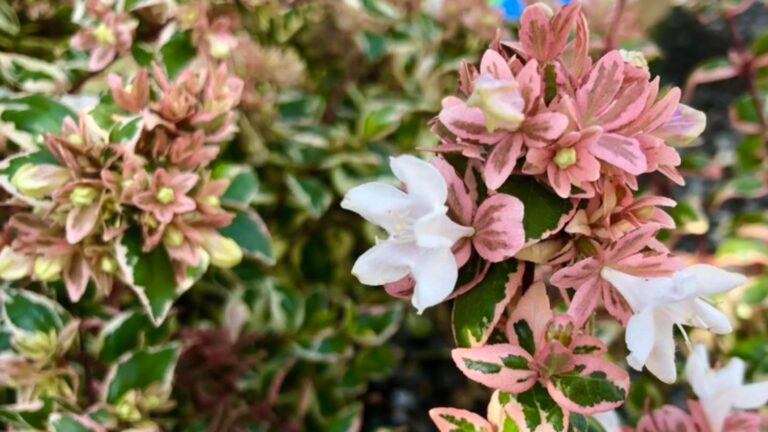
For edging walkways, defining garden beds, or creating low borders, compact varieties work best. ‘Rose Creek’ grows 2-3 feet tall with a 3-4 foot spread and develops dense growth ideal for tidy, low hedges[5]. The white flowers with rosy pink sepals bloom from late spring to fall, and foliage turns purple in cool weather.
‘Kaleidoscope’ reaches 2-3 feet tall and 3-4 feet wide, offering dramatic foliage that shifts from golden-yellow in spring to orange-red in fall[6]. This variety works particularly well where you want colorful low screening without frequent trimming. For detailed variety information, our variety comparison guide breaks down characteristics for each cultivar.
‘Little Richard’ and ‘Radiance’ also fall into this compact category, making them suitable for low hedges along garden edges where a formal or semi-formal appearance is desired[5].
Medium Hedges (3-5 Feet)
Medium-height hedges suit property boundaries, garden room dividers, and foundation screens. ‘Edward Goucher’ grows 3-5 feet tall depending on climate, producing lavender-pink flowers with distinctive orangish-yellow throats[7]. This variety reaches its maximum height in warmer zones (8-9) while staying more compact in cooler areas.
‘Canyon Creek’ reaches 4-6 feet with coppery-pink new growth that matures to green, making it excellent for taller informal screens[8]. The light pink flowers and bronze fall color add seasonal interest to hedge plantings.
Tall Screens (6+ Feet)
Standard Glossy Abelia (Abelia × grandiflora) grows 6-10 feet tall with a 6-foot spread when left unpruned[9]. This size range makes it suitable for privacy screens and windbreaks. The arching branches cascade gracefully, creating a natural, flowing appearance rather than a rigid barrier.
For maximum screening height, allow plants to develop their natural vase-shaped form with minimal pruning. Planting on 4-6 foot centers creates effective screens or foundation plantings[9].
Planning Your Abelia Hedge
Proper planning before planting ensures your hedge fills in uniformly and performs well for decades. Consider these factors when establishing new plantings.
Site Selection
Abelia grows in full sun to partial shade, but 6 hours of direct sunlight produces the densest growth and most abundant flowering[1]. Hedges planted in heavy shade become thin, leggy, and flower poorly. For guidance on optimal locations, see our article on where to plant abelia.
The shrub tolerates most soil types but requires good drainage. Before planting, test drainage by digging a 12-inch hole, filling it with water, and timing how long it takes to drain. Well-drained soil drains at approximately 1 inch per hour[4].
Abelia prefers slightly acidic to neutral soil with a pH between 5.0 and 7.5[4]. Most garden soils fall within this range without amendment.
Spacing Guidelines
Plant spacing directly affects how quickly your hedge fills in and its final density. The general principle: closer spacing creates faster establishment but requires more plants.
| Hedge Type | Spacing | Plants per 10 ft | Fill-in Time |
|---|---|---|---|
| Dense formal hedge | 2-3 ft apart | 4-5 plants | 2-3 years |
| Informal screen | 3-5 ft apart | 2-3 plants | 3-4 years |
| Privacy screen | 4-6 ft centers | 2 plants | 4-5 years |
For dwarf varieties like ‘Kaleidoscope’ or ‘Rose Creek’, planting 2-3 feet apart creates seamless low hedges[10]. Larger varieties need 3-5 feet between plants to allow adequate air circulation and light penetration[1].
Always base spacing on the specific variety’s mature width. A variety that spreads 4-5 feet wide planted at 3-foot intervals will grow together into a solid mass, while the same plant spaced 6 feet apart creates individual specimens rather than a continuous hedge. For detailed measurements, check our spacing guidelines.
Planting Your Abelia Hedge
Proper planting technique establishes strong root systems that support vigorous hedge growth. Follow these steps for best results.
Timing
Plant abelia in spring or fall during milder months to avoid heat or cold stress[2]. Fall planting allows root establishment before summer heat, while spring planting gives plants a full growing season to develop.
Planting Steps
Dig holes twice as wide as the root ball and as deep[1]. This loosened soil area encourages rapid root expansion. Space holes according to your variety’s requirements.
Amend heavy clay or sandy soils by mixing in compost at a 25-50% ratio with native soil[4]. Place each plant so the top of the root ball sits slightly above the surrounding soil level to prevent water pooling at the crown[5].
Backfill around the root ball, tamping soil gently to eliminate air pockets. Water deeply immediately after planting to settle soil around roots. Apply 2-3 inches of mulch around plants, keeping it several inches away from stems to prevent rot[1]. Our hedge planting guide covers additional techniques for successful establishment.
Establishing Your Hedge
The first year after planting determines long-term hedge health. Focus on consistent moisture and proper early care.
Watering During Establishment
Water newly planted hedges regularly during the first growing season to establish deep root systems[1]. Check soil moisture frequently—the goal is consistently moist but not waterlogged soil.
After the first 8 weeks, reduce watering frequency but continue deep irrigation during dry periods. Once established (typically after 2-3 months), abelia becomes drought tolerant and requires only occasional watering during extended dry spells[5].
Set automated irrigation to run in early morning hours rather than evening, which can promote fungal diseases[4]. For specific watering schedules, visit our watering requirements guide.
Established hedges require additional watering primarily during hot, dry summer periods.
Early Pruning for Density
New hedge plants benefit from light tip pruning during their first growing season. Pinching or trimming growing tips encourages lateral branching and creates denser plants from the base up[11].
Avoid heavy pruning during establishment—plants need foliage to produce energy for root development. Wait until late winter of the second year for more substantial shaping.
Pruning Abelia Hedges
Pruning techniques determine whether your hedge maintains a formal or informal character. The timing and method you choose affects both appearance and flowering.
When to Prune
Late winter to early spring is the optimal time for major pruning before new growth begins[6]. This timing allows you to:
- Remove winter-damaged wood
- Shape the overall form
- Encourage dense new growth
- Maximize flower production on new wood
Light shaping can occur after flowering ends if you want to tidy plants without sacrificing many blooms. Cease pruning 2 months before the first expected frost to avoid stimulating tender new growth that could suffer cold damage[4].
Formal Hedge Maintenance
Formal hedges require regular shearing to maintain geometric shapes. Use hedge trimmers to clip plants 2-3 times during the growing season[4]. Keep in mind that each shearing removes developing flower buds, so formal hedges typically produce fewer blooms than informal ones.
When shearing, trim the top narrower than the base to allow light to reach lower branches[11]. Hedges pruned with straight vertical sides shade lower foliage, causing it to thin and die back—creating bare legs that defeat the purpose of screening.
Consider whether a formal appearance is worth reduced flowering. Many gardeners choose a semi-formal approach: one or two shapings per year rather than constant clipping.
Informal Hedge Care
Informal hedges require less maintenance and produce more flowers. Rather than shearing, use hand pruners to selectively remove individual branches that extend beyond the desired form[11].
Annual pruning in late winter involves:
- Removing dead, damaged, or crossing branches
- Cutting back stray shoots to just above the main form
- Thinning older canes to stimulate new growth from the base
This selective approach maintains the plant’s natural arching habit while controlling size. Detailed techniques are available in our pruning guide.
Pro tip: Remove no more than one-third of the plant’s growth in any single year to maintain plant health.
Rejuvenation Pruning
Older hedges that have become thin, leggy, or overgrown benefit from rejuvenation pruning. This involves cutting the entire hedge back to 6-12 inches above ground level in late winter[11].
New shoots emerge in spring, and by midsummer the hedge fills out with fresh, vigorous growth. Once new shoots reach 6-12 inches long, pinch tips to encourage lateral branching[11].
Rejuvenation pruning works well on most broadleaf shrubs including abelia but stresses weak or diseased plants. Assess plant health before attempting this drastic measure.
Creating Privacy Screens
Privacy screens serve different purposes than low hedges and require adjusted techniques for best results.
Height Considerations
For effective visual screening, most backyards need screens reaching 6-8 feet at maturity[2]. Select varieties capable of reaching this height, such as standard Glossy Abelia or ‘Edward Goucher’ in warm climates.
Avoid over-planting—screens taller than 15-18 feet can create a claustrophobic effect and shade lawn areas excessively[12].
Maintaining Density
Taller abelia plants naturally develop a vase shape with fuller tops and thinner bases. To maintain screening at all heights:
- Prune to keep the base wider than the top
- Periodically thin interior branches to allow light penetration
- Remove some older canes annually to stimulate basal growth
Thinning helps light reach interior foliage, stimulating branching and creating a fuller plant throughout[9].
Mixed Species Screens
Consider combining abelia with complementary shrubs for layered screening. Pairing abelia with hydrangea, boxwood, or spirea creates visual interest through varied textures and staggered bloom times[1].
Mixed hedges look more natural and attract more beneficial wildlife than single-species plantings. The arching form of abelia contrasts nicely with the more rigid structure of boxwood or the large flowers of hydrangea.
Ongoing Maintenance
Established abelia hedges require minimal care compared to many hedge plants, but consistent attention keeps them looking their best.
Fertilizing
Apply a balanced, slow-release fertilizer in early spring as new growth begins[1]. A second light feeding in midsummer can promote continued blooming on varieties that flower until frost.
Avoid over-fertilizing, which produces excessive leafy growth at the expense of flowers. Abelia naturally thrives with moderate fertility. For complete fertilizer recommendations, see our fertilizing schedule.
Mulching
Maintain a 2-3 inch layer of mulch around hedge plants to conserve moisture, regulate soil temperature, and suppress weeds[1]. Replenish mulch annually as it decomposes.
In areas with strong winter freezes, apply fresh mulch in fall to protect roots. Keep mulch away from plant stems to prevent moisture-related diseases.
Pest and Disease Management
Abelia has no serious pest or disease problems[3]. Occasionally aphids may appear on new growth, but populations rarely reach damaging levels. The plant’s natural disease resistance and tolerance to pruning enhance its usefulness for hedging.
If you notice problems, our troubleshooting guide addresses common issues and solutions.
Varieties for Specific Hedge Situations
Matching varieties to site conditions produces the best results. Consider these recommendations for particular situations.
| Situation | Recommended Varieties | Notes |
|---|---|---|
| Walkway borders | ‘Rose Creek’, ‘Radiance’ | Dense, compact growth |
| Property lines | ‘Canyon Creek’, Glossy Abelia | Taller, fuller screening |
| Formal gardens | ‘Little Richard’, ‘Kaleidoscope’ | Respond well to shaping |
| Low maintenance | ‘Edward Goucher’ | Minimal pruning needed |
| Containers/patios | Dwarf varieties | See compact varieties |
For help selecting among cultivars with different characteristics, visit our companion planting guide to learn which plants pair well with specific abelia varieties.
Common Hedge Problems and Solutions
Even well-maintained hedges occasionally develop issues. Address problems promptly to maintain hedge health.
Bare Legs
Lower branches lose foliage when shaded by top growth. Prevent this by:
- Pruning the top narrower than the base
- Thinning interior branches to improve light penetration
- Reducing shearing frequency
Once lower branches die back, rejuvenation pruning may be the only solution.
Uneven Growth
Hedges develop uneven sections when individual plants grow at different rates. This commonly results from:
- Inconsistent soil conditions along the hedge line
- Shade from nearby trees or structures affecting part of the hedge
- Root competition from established trees
Address underlying causes and prune more vigorously in areas with excessive growth.
Winter Damage
In zone 6, abelia may die back partially during harsh winters. Plants typically regenerate from roots in spring. Remove dead wood in late winter after frost danger passes, and allow new growth to fill gaps naturally.
If you’re exploring abelia for hedging applications, understanding its landscape uses provides additional context for incorporating this shrub into your design.
Conclusion
Abelia creates attractive, functional hedges that combine flowering beauty with practical screening. Success depends on selecting varieties matched to your height requirements, spacing plants according to their mature width, and maintaining appropriate pruning schedules. Whether you choose compact cultivars for low borders or full-sized specimens for privacy screens, proper establishment and ongoing care produces hedges that enhance your landscape for decades. Start by selecting your varieties and calculating spacing based on your hedge length, then prepare the site with amended soil and plant during favorable weather in spring or fall.
Key Sources:
[1] The Abelia Guide | Plant Detectives
[2] Growing Abelia – How to Plant and Care for Glossy Abelia Plants | Garden Design
[3] Abelia x grandiflora (Glossy Abelia) | NC State Extension
[4] How To Plant, Prune, Fertilize & Water Abelia Shrubs | Wilson Bros Gardens
[5] Abelia Varieties Collection | PlantingTree
[6] Abelia Collection | Oklahoma State University Extension
[7] Abelia ‘Edward Goucher’ | NC State Extension
[8] Abelia – Tough But Beautiful | Piedmont Master Gardeners
[9] Abelia x grandiflora: Glossy Abelia | University of Florida IFAS Extension
[10] Creating A Beautiful Abelia Hedge: A Step-By-Step Guide | ShunCy
[11] Pruning Shrubs | Clemson University Home & Garden Information Center
[12] Greenwalls: Grow Your Own Privacy Screen | Central Virginia HOME Magazine