What is Abelia? Plant Characteristics, Benefits & Garden Value
Your neighbor’s garden stays alive with buzzing pollinators while yours falls silent by midsummer. The difference often comes down to plant selection, and abelia ranks among the most reliable pollinator magnets available to home gardeners[1]. This graceful shrub produces fragrant tubular flowers continuously from late spring through frost, making it a nonstop food source for butterflies, hummingbirds, and bees[2]. Here’s everything you need to know about this underappreciated garden workhorse.
Abelia at a Glance: Botanical Background and Origins
Abelia belongs to the honeysuckle family Caprifoliaceae, a plant group that includes many fragrant, tubular-flowered shrubs[3]. The genus currently contains six accepted species native to China, Taiwan, and Vietnam, though it previously included about 30 species and hybrids before molecular studies led to reclassification[3].
The genus name honors Dr. Clarke Abel (1780-1826), a British physician and naturalist who collected seed and plant specimens during an embassy to China in 1816-1817[4]. All of Abel’s collected seeds and plants were lost in a shipwreck on the homeward voyage, but living plants of Abelia chinensis were eventually imported to England in 1844 by the plant collector Robert Fortune[4].
The most commonly grown species in gardens today is glossy abelia (Abelia × grandiflora), a hybrid created around 1886 by crossing Abelia chinensis with Abelia uniflora at the Rovelli nursery in Italy[5]. This hybrid combines the best traits of both parent species, resulting in a plant prized for its long bloom season, glossy foliage, and adaptable nature. Understanding your hardiness zone and climate requirements helps determine which abelia varieties will perform best in your specific location.
Physical Characteristics: What Does Abelia Look Like?
Abelia shrubs develop a multi-stemmed, arching growth habit that creates a graceful, fountain-like appearance in the landscape[6]. The plants typically reach 3 to 6 feet tall and wide at maturity, though dwarf cultivars stay more compact at 2 to 3 feet[7]. Growth occurs at a moderate rate of 1 to 2 feet per year under optimal conditions[8].
Foliage Features
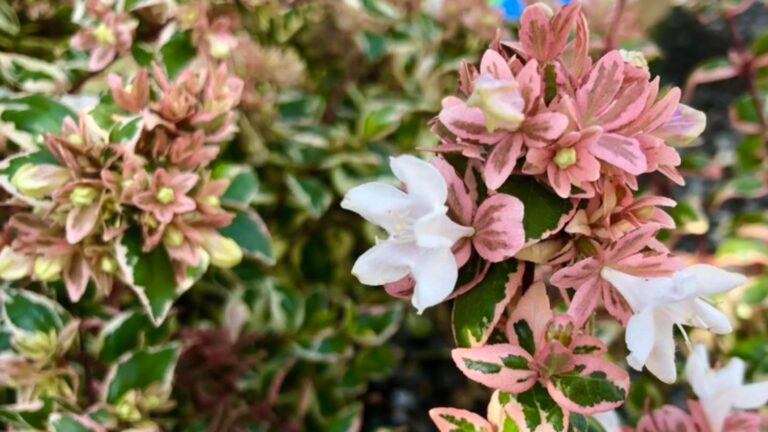
The leaves are one of abelia’s standout characteristics. Oval and pointed, they measure up to two inches long and appear on slender, reddish stems[2]. The foliage emerges with a bronze or reddish tint in spring, matures to glossy dark green in summer, and often transitions to purplish-bronze or copper tones in autumn[9].
Many modern cultivars display variegated foliage with striking color combinations. ‘Kaleidoscope’ produces leaves that shift from lime-green with bright yellow edges in spring to golden yellow in summer, then fiery orange and red in fall[10]. ‘Confetti’ features cream-variegated leaves that turn reddish in cool temperatures[11]. This seasonal color progression provides year-round visual interest, extending ornamental value well beyond the flowering season.
Flower Characteristics
The tubular, bell-shaped flowers measure approximately half an inch long and appear in clusters at the stem tips and in upper leaf axils[11]. Colors range from pure white to pink, depending on the variety, and most emit a light, pleasant fragrance[2]. For detailed information about bloom times and flower colors, consult our guide to flowering and bloom characteristics.
Pro tip: The persistent pink or reddish sepals remain on the plant long after flowers fade, extending the colorful display well into fall.
One of abelia’s most valuable traits is its exceptionally long bloom period. Flowers begin appearing in late spring and continue until the first hard frost, often spanning five to six months of continuous bloom[12]. This extended flowering window makes abelia one of the longest-blooming shrubs available for temperate gardens.
Abelia’s Evergreen or Deciduous Nature
Abelia’s foliage behavior varies by climate and specific variety, which affects how the plant integrates into your landscape design. Understanding evergreen versus deciduous behavior in your zone helps with planning.
In USDA zones 9 to 11, glossy abelia behaves as an evergreen, retaining attractive foliage throughout the year[11]. In zone 8, the shrub is typically semi-evergreen to deciduous, losing some leaves during winter while others take on deeper red coloration[13]. In zones 6 to 7, plants may freeze back to the ground during harsh winters but will regrow from the roots in spring[11].
The bark provides winter interest on older stems, peeling in thin strips to reveal lighter inner layers in shades of pale gray to reddish-purple[9]. This exfoliating bark adds texture and visual appeal even when leaves have dropped.
Wildlife Value: A Pollinator Powerhouse
Few shrubs match abelia’s appeal to beneficial wildlife. The fragrant tubular flowers serve as a continuous nectar source that attracts an impressive array of pollinators and wildlife throughout the growing season[1].
Butterflies rank among the most frequent visitors, drawn by the flower shape and extended bloom period. Hummingbirds find the tubular flower form ideal for feeding. Various bee species, including honeybees and native bees, work the flowers heavily throughout summer and fall[14].
A horticulturist at the University of Georgia described abelia as a plant you could plant beside a gas station surrounded by asphalt and forget about, and it would still survive and thrive[15]. This toughness combined with exceptional wildlife value makes abelia an ideal choice for anyone wanting to support pollinators without high-maintenance gardening.
Growing Conditions: What Abelia Needs to Thrive
Abelia adapts to a surprisingly wide range of growing conditions, contributing to its reputation as a low-maintenance landscape plant. Understanding basic sunlight requirements helps maximize both flowering and foliage color.
Light Requirements
Full sun produces the best flowering and most vibrant foliage colors, with plants performing optimally when receiving at least 6 hours of direct sunlight daily[16]. Partial shade is tolerated, though expect reduced bloom production and a more open growth habit in shadier locations[7].
Soil Preferences
Abelia thrives in moist, well-drained soil enriched with organic matter but tolerates a variety of soil types including loam, clay, and sandy soils[16]. A slightly acidic pH is ideal, though plants adapt to most garden conditions.
Water Needs
Regular watering during the first growing season establishes deep roots, after which abelia becomes quite drought tolerant[11]. This ability to withstand dry periods once established makes it suitable for water-wise gardening approaches.
Hardiness Range: Where Abelia Grows Best
Most abelia varieties perform well in USDA hardiness zones 6 through 9, tolerating temperatures as low as approximately -10°F[17]. Some newer cultivars extend this range. Sweet Emotion® abelia (Abelia mosanensis) survives in chilly zone 4, expanding options for gardeners in colder climates[18].
In colder zones, several factors affect winter survival. Selecting a protected planting site helps prevent freeze damage, and applying a thick layer of mulch around the base protects roots from extreme cold[19]. Because glossy abelia flowers on new wood, even if stems die back in winter, plants will still bloom on the regrowth[20].
Landscape Uses: How to Incorporate Abelia in Your Garden
Abelia’s versatility makes it suitable for numerous landscape applications. The graceful arching form and extended bloom period work effectively in both formal and informal settings.
Common landscape applications include:
- Foundation plantings along home exteriors
- Informal hedges and screening
- Mixed shrub borders
- Mass plantings on slopes for erosion control
- Specimen or focal point plantings
- Container gardening with dwarf varieties
When planning where to plant abelia, consider mature size and ensure adequate space for the arching branches to develop naturally. For hedges, plant on 3 to 5 foot centers depending on the variety selected[13]. The plants respond well to pruning if a more formal shape is desired.
| Landscape Use | Recommended Spacing | Best Varieties |
|---|---|---|
| Foundation planting | 4-6 feet | ‘Little Richard’, ‘Rose Creek’ |
| Informal hedge | 3-5 feet | Glossy Abelia, ‘Edward Goucher’ |
| Mass planting | 3-4 feet | ‘Kaleidoscope’, ‘Confetti’ |
| Container | Single specimen | Any dwarf variety |
Popular Abelia Varieties
The variety comparison between cultivars reveals options for virtually any garden situation. Here are some widely available selections worth considering:
‘Kaleidoscope’ grows 2 to 3 feet tall and 3 to 4 feet wide, featuring dramatic seasonal foliage color changes from golden yellow to fiery red[10]. Its compact size suits smaller gardens and containers.
‘Rose Creek’ reaches 2 to 3 feet tall with a mounded habit, glossy green leaves that turn purplish in fall, and abundant white flowers[21]. Developed by Michael Dirr at the University of Georgia, it offers excellent disease resistance.
‘Edward Goucher’ produces distinctive lavender-pink flowers and reaches 3 to 5 feet tall in most climates[22]. Less cold hardy than glossy abelia, it performs best in zones 6a and warmer.
‘Little Richard’ stays compact at 2 to 3 feet, with bright red new growth that matures to glossy green and takes on orange-pink fall color[11].
Low Maintenance Requirements
Abelia earns its reputation as a practically care-free shrub through impressive resistance to common garden problems. The plants exhibit no serious pest or disease issues, with only occasional aphid infestations that rarely cause significant damage[11].
This shrub is considered deer resistant, though no plant is completely immune when deer populations are high and food sources scarce[23]. Rabbits also typically avoid abelia, making it a reliable choice for areas with wildlife pressure[16].
Once established, maintenance involves little more than occasional pruning to maintain shape or control size. Because flowering occurs on new wood, plants can be pruned heavily in late winter or early spring without sacrificing blooms[11]. For detailed care information, our comprehensive abelia guide covers all aspects of cultivation.
Getting Started with Abelia
Adding abelia to your garden starts with selecting the right variety for your space and conditions. Dwarf cultivars work well in containers and small gardens, while larger varieties suit hedging and screening applications.
The shrub pairs effectively with many companion plants sharing similar cultural requirements. Consider combining with spirea, maiden grass, weigela, or flowering perennials that complement the arching form and seasonal color changes[2].
Abelia represents an outstanding choice for gardeners seeking a tough, beautiful shrub that delivers months of flowers, year-round foliage interest, and exceptional wildlife value. Few plants offer this combination of ornamental features with such minimal care requirements.
Conclusion
Abelia stands out as a versatile flowering shrub that combines attractive foliage, extended bloom periods, and pollinator value with remarkably low maintenance requirements. Whether you’re establishing a pollinator garden, seeking foundation plantings, or adding seasonal interest to mixed borders, this adaptable shrub delivers reliable performance across a range of conditions. Explore our complete abelia growing guide to learn everything needed for successful cultivation.
Key Sources:
[1] Growing Abelia – How to Plant and Care for Glossy Abelia Plants | Garden Design
[2] Growing Abelia – How to Plant and Care for Glossy Abelia Plants | Garden Design
[3] Abelia – Wikipedia
[4] Abelia–Tough But Beautiful – Piedmont Master Gardeners
[5] Abelia × grandiflora – Wikipedia
[6] Glossy abelia | The Morton Arboretum
[7] Abelia x grandiflora (Glossy Abelia) | North Carolina Extension Gardener Plant Toolbox
[8] Abelia Varieties Collection | PlantingTree.com
[9] Abelia × grandiflora | Grokipedia
[10] Kaleidoscope Variegated Abelia | Plants Express
[11] Abelia x grandiflora (Glossy Abelia) | North Carolina Extension Gardener Plant Toolbox
[12] Glossy Abelia (Abelia x grandiflora) | University of Arkansas
[13] FPS 001/FP001: Abelia x grandiflora: Glossy Abelia | University of Florida IFAS Extension
[14] Growing Abelias for Summer Color and the Pollinators | Dave’s Garden
[15] Abelia–Tough But Beautiful – Piedmont Master Gardeners
[16] The Abelia Guide – Plant Detectives
[17] Optimal Hardiness Zones for Abelia | Greg App
[18] Sweet Emotion® – Hardy Abelia mosanensis | Proven Winners
[19] Abelia x grandiflora ‘Little Richard’ (Glossy Abelia) | Gardenia
[20] Growing Abelias for Summer Color and the Pollinators | Dave’s Garden
[21] Abelia Varieties Collection | PlantingTree.com
[22] Abelia–Tough But Beautiful – Piedmont Master Gardeners
[23] Are Abelia Deer Resistant? | Plant Addicts